Thank you to Karen ievers for spotting this book on Bees, now safely back at Chawton House after a successful and not that expensive auction bidding adventure [auction was in German! – one musters through…]
It is in the 1818 GPL catalogue, so another Lost Sheep returns!

Title: A Treatise on the Management of Bees; wherein is contained The Natural History of those Insects; With the various Methods of cultivating them, both Antient and Modern, and the improved Treatment of them. To which are added, The Natural History of Wasps and Hornets, and the Means of destroying them. Illustrated with Copper-Plates. By Thomas Wildman.
Author: Wildman, Thomas (d. 1781)
Date Published: 1768. 1st edition.
Publisher: London:Printed for the Author, and sold by T. Cadell, opposite Catharine-Street, in the Strand.
Location: West case: column 1, shelf 6
In 1908 Catalogue: Yes
**********
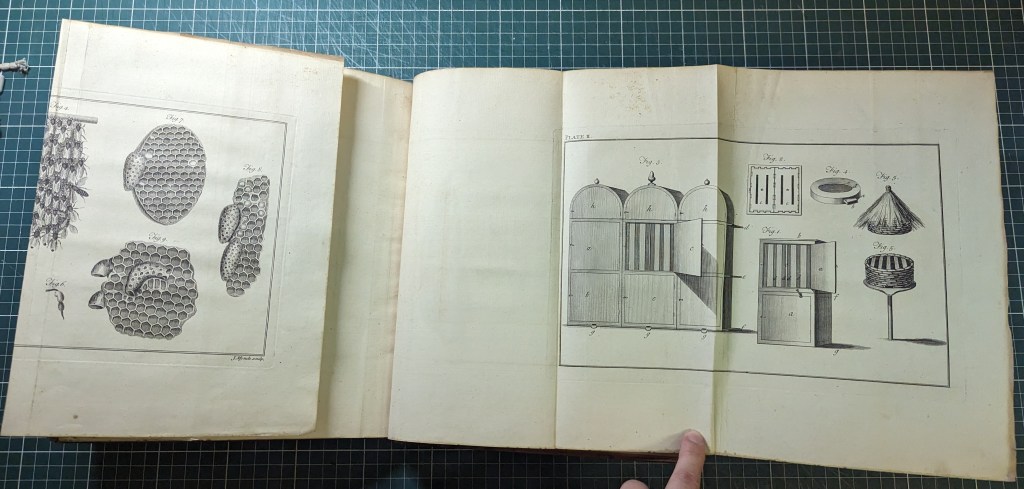
The auction catalogue listed it as having the bookplate of Montagu George Knight of Chawton – and Karen’s eagle eyes spotted it for us. Emma at Chawton House has sent along a few pictures which will be added to the website soon:


****************
This is what the Royal Collection Trust has to say about Wildman’s book:
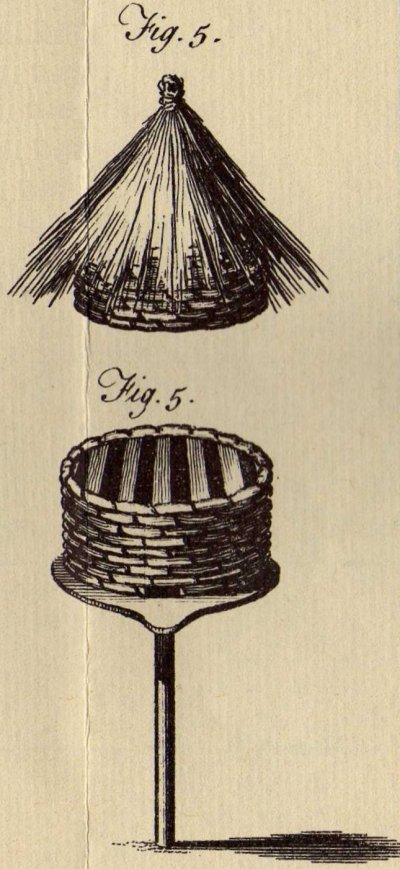
A Treatise on the Management of Bees is a manual on beekeeping and a natural history of bees, wasps and hornets by the English beekeeper Thomas Wildman. Published in 1768, the book offered new advice for the management of bees and demonstrated Wildman’s new design for hives. Wildman’s hive included a removable woven lid and a set of seven frames from which bees could build their honeycomb. He also advocated for the use of multiple skeps (domed baskets used for beehives) so that bees could freely move to a new skep once the old one was full, allowing for the easy retrieval of honey. These innovations removed the need to suffocate the colony prior to the harvesting of honey, allowing for the bees to survive for many years.
Modern hives follow similar principles to Wildman’s innovations, however, box hives, where the bees and their honeycomb can be easily observed for signs of disease, have replaced skeps in many areas.
Source: Royal Collection Trust: https://www.rct.uk/collection/1057028/a-treatise-of-the-management-of-bees-wherein-is-contained-the-natural-history-of
***************
There is not much on Wildman, but I find this little bit in a catalogue of bee books by Walker [Walker, Lt.-Col. H.J.O. Catalogue of Bee Books, Collected and Offered for Sale by Lt.-Col. H.J.O. Walker, Westholm Mains, Budleigh Salterton, Devon. West Yorkshire: Northern Bee Books, 1985.]:
“Thomas and Daniel Wildman, uncle and nephew, both achieved fame by trick performances with bees… Thomas, a Plymouth man, came to London in 1766…the journals of the day report his exploits… His treatise shows…an unusual knowledge of Continental bee-keeping…” (Walker, p. 78).
He also published A Treatise on the Culture of Peach Trees, Printed for the author, 1768: this is a an English translation of the highly respected Traite de la culture des pecher , first published in Paris in 1745 by de Combles
And it is always fun to run into unexpected and interesting book history: Benjamin Franklin was a subscriber to Wildman’s Bees!

[Now I confess to not scrolling through the list to find this – a grand pursuit if someone wants to read through all the subscribers here – no Austens noted but all sorts of worthies of the time are]: scroll down a few pages to the “Subscribers” list]
Wildman’s Bees at google books
I found the Franklin tidbit in this 2014 Guardian article on beekeepers [to include Sherlock Holmes of course]:
https://www.theguardian.com/culture/2014/jul/04/the-10-best-famous-beekeepers
And if you are into bees and beekeeping, this is a great summary of the history at Powerblanket, Wildman included.
Question is:
Did Edward Knight keep bees? We know his brother Charles was very much into natural history [more than his clerical duties it seems], but were bees kept at Godmersham or Chawton? Anyone know?
 Reading with Austen